
Scroll through your Instagram, Facebook, or LinkedIn feed right now. What stops you in your tracks?
Chances are, it’s movement. With the massive rise of Reels, YouTube Shorts, and TikTok, the digital landscape has shifted entirely toward motion content. But for business owners and marketers in India trying to maximize their budget, the debate of Video Ads vs Static Images is crucial.
Producing high-quality video takes time, money, and editing skills. A static image design is faster and cheaper to produce. So, is the extra effort for video actually worth it? Which format puts more money in the bank?
In this post, we break down the pros and cons of both to see which wins the battle for ROI in 2025.
1. The Case for Static Images: Speed and Clarity
Static images are definitely not dead. In fact, for certain campaign goals, they still perform exceptionally well.
- Instant Message Consumption: A user sees a static ad and understands the message in 0.5 seconds. There is no need to wait for a “hook” to develop.
- Lower Production Cost: You can design a high-quality static ad in tools like Canva or Photoshop in under an hour with minimal budget.
- Higher CTR for Retargeting: When a user already knows your brand and just needs a nudge, a simple static image with a big “50% OFF” discount often works better than re-explaining the product in a video.
Best Use Case: Catalog sales, flash sales, and bottom-of-funnel retargeting.
2. The Case for Video Ads: Engagement and Trust
When it comes to building trust and stopping the scroll, video is undisputed king. According to recent video marketing statistics, video content generates significantly more engagement across nearly all social platforms.
- Storytelling Power: You can explain complex services (like interior design or software consulting) much better in a 30-second video than in a single flat image.
- Algorithm Preference: Platforms like Instagram aggressively push video content to compete with TikTok. Your video ad is likely to get more impressions for a lower cost (CPM) than a static image because the platform wants more video.
- Emotional Connection: Seeing a real person talking, or a product being used in real life, builds credibility that a graphic design cannot match.
Best Use Case: Brand awareness, explaining a new product, and targeting cold audiences.
3. The Verdict: The Hybrid Approach
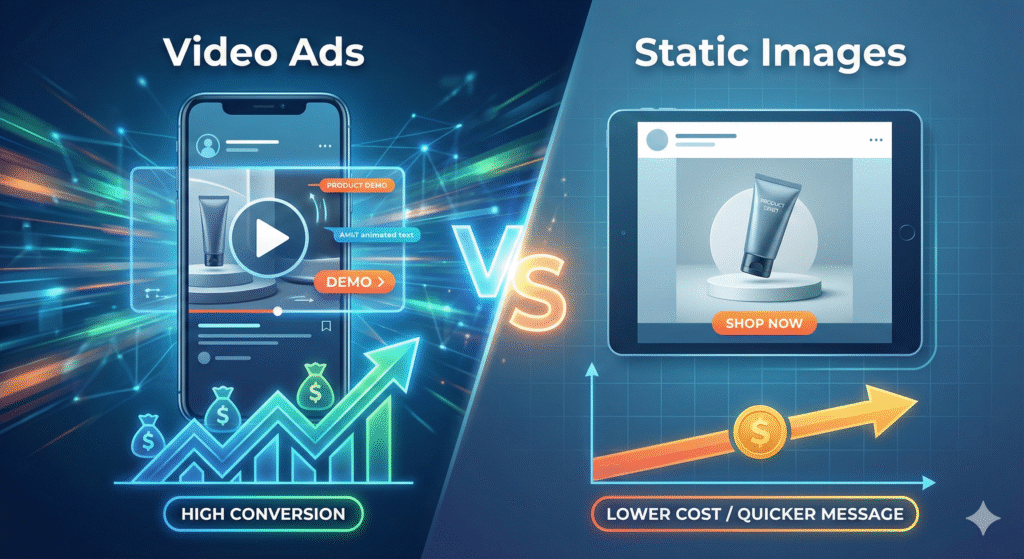
When analyzing Video Ads vs Static Images, the data usually shows a clear trend:
Video Ads tend to have a higher conversion rate for new customers because they educate the user better before the click.
Static Ads often have a lower Cost Per Click (CPC) because they are simpler.
According to Meta Business marketing guides, the winning strategy for 2025 is rarely “one or the other.” It is the Hybrid Approach:
- Use Video Ads at the top of the funnel to grab attention and introduce your brand.
- Use Static Images to retarget the people who watched the video with a specific offer to close the sale.
Conclusion
If your marketing strategy still relies 100% on static graphics, you are leaving money on the table in the current digital environment. You don’t need a cinema-quality production; simple, authentic videos often outperform expensive ones.
Need high-converting video ads for your brand? At Adeluxe.in, we combine creative storytelling with performance data to produce video ads that stop the scroll. Check out our Video Ad Services and start driving real engagement today